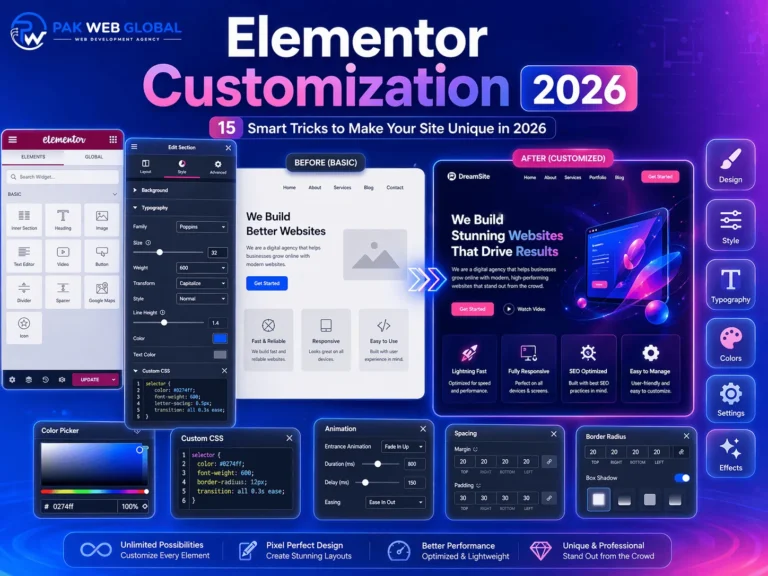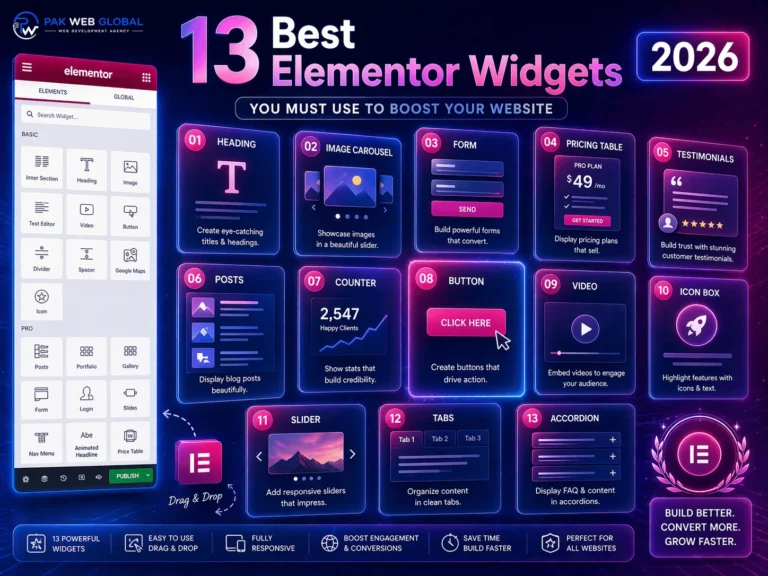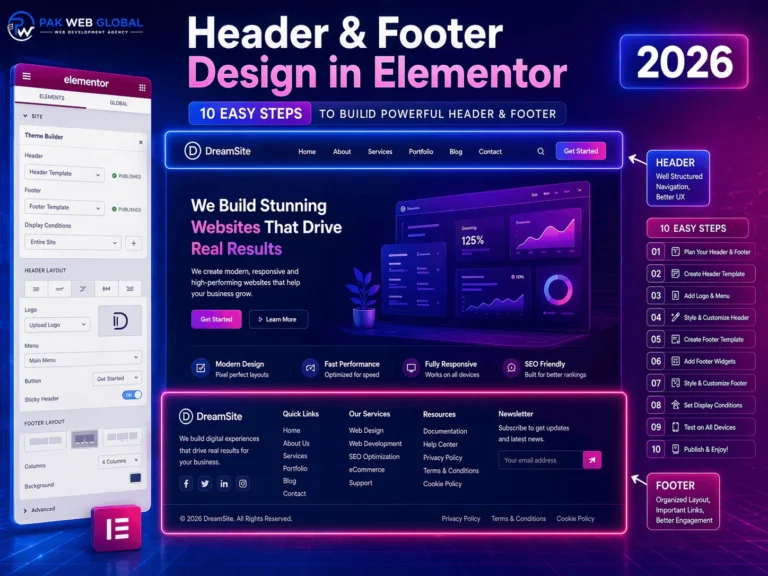
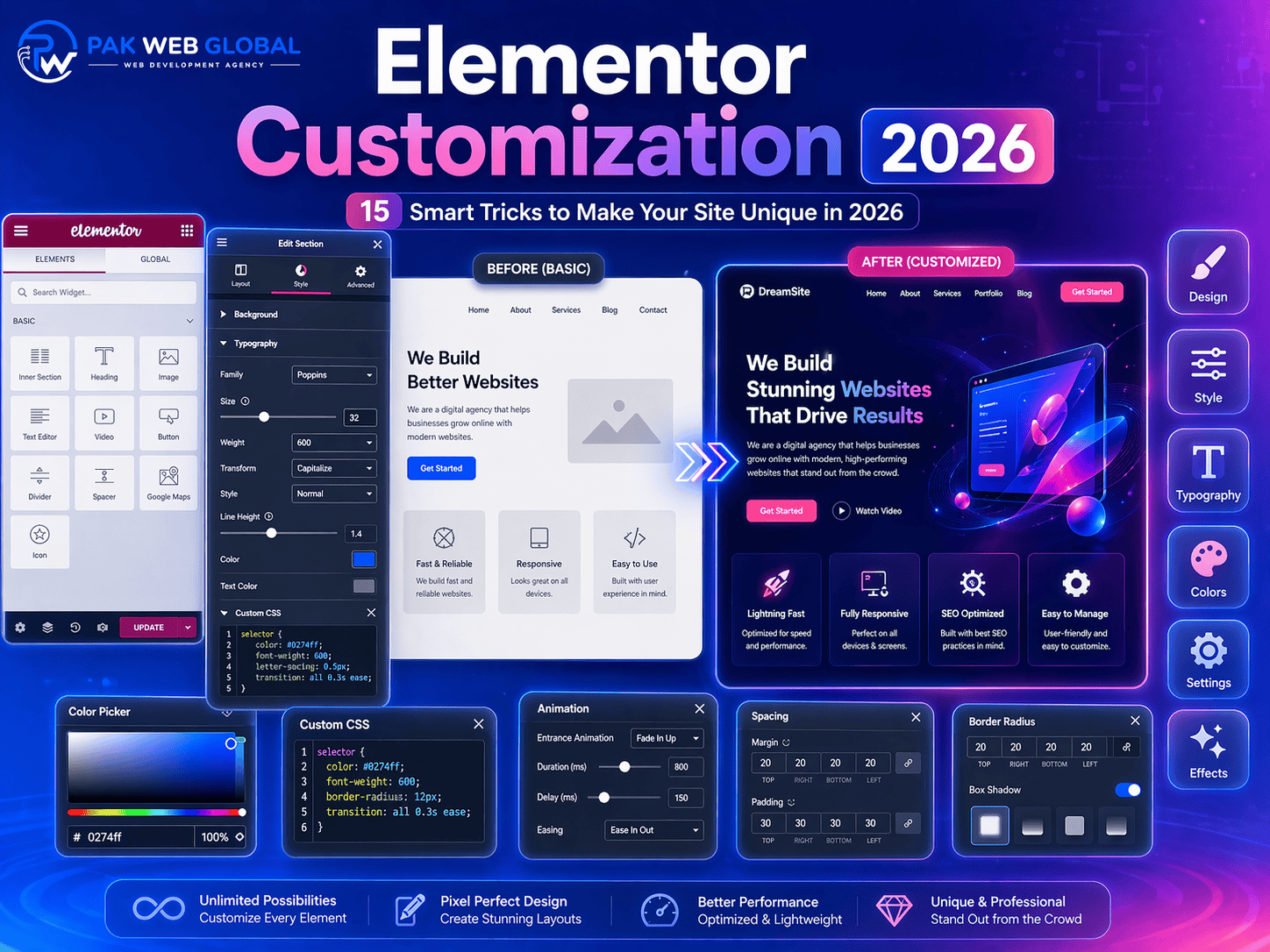
If you’re searching for a complete Elementor customization guide in 2026, you’re in the right place. The web is more competitive than ever, and a slow, outdated, or poorly configured website loses visitors in seconds. At PakWebGlobal, we have helped hundreds of clients design, fix, scale, and rank their websites — and this guide compiles everything we wish every site owner knew about Elementor customization today.
Whether you are a beginner who just installed WordPress, a small business owner, an agency designer, or a developer building for clients, this article walks you through Elementor customization step by step in plain English. You will learn the modern best practices, see the exact tools we use in real projects, avoid the common mistakes, and walk away with an action plan you can apply this week.
This article is updated for 2026 with the latest tools, plugins, AI helpers, Core Web Vitals expectations, and Google ranking signals. Let’s dive into the world of Elementor customization the right way.
Table of Contents
- What is Elementor customization?
- Why Elementor customization Matters in 2026
- Step-by-Step Elementor customization Guide
- Best Practices for Elementor customization
- Recommended Tools and Plugins for Elementor customization
- Common Mistakes to Avoid in Elementor customization
- Pro Tips From the PakWebGlobal Team
- Real-World Example: A PakWebGlobal Case Study
- How Elementor customization Compares to Alternative Approaches
- Your Elementor customization Checklist
- Frequently Asked Questions About Elementor customization
- Conclusion: Master Elementor customization With PakWebGlobal
What is Elementor customization?
Elementor customization refers to the modern set of techniques, tools, and best practices used to plan, build, customize, optimize, and grow a website powered by Elementor. In 2026, Elementor customization is no longer a “nice to have” — it is a core skill for anyone serious about building an online business, portfolio, agency, blog, or ecommerce store.
At its heart, Elementor customization blends three disciplines:
- Design — choosing the right layout, theme, typography, color, and visual hierarchy.
- Engineering — configuring plugins, code snippets, hosting, caching, security, and performance.
- Growth — SEO, content strategy, analytics, conversion rate optimization, and marketing.
The goal of Elementor customization in 2026 is simple: deliver a fast, accessible, secure, and conversion-focused experience that ranks on Google and converts visitors into customers.
Who is this guide for?
This guide is written for beginners, intermediate WordPress users, small business owners, agency designers, freelancers, and developers who want a single source of truth on Elementor customization. You don’t need any prior coding knowledge to follow along — but if you do code, we will share advanced tips you’ll appreciate.
Why Elementor customization matters more than ever in 2026
Search engines have become smarter. Visitors are pickier. Competitors are everywhere. Mastering Elementor customization is the difference between a site that disappears on page 10 of Google and a site that drives leads, sales, and authority on autopilot. Companies that ignore modern Elementor customization practices in 2026 lose around 40% of their potential traffic to better-optimized competitors.
Why Elementor customization Matters in 2026
The digital landscape has shifted dramatically over the past three years. AI-driven search, Core Web Vitals, mobile-first indexing, and stricter privacy laws have all changed how websites are built and ranked. Elementor customization sits right at the center of all these changes.
Here is what is driving the renewed importance of Elementor customization in 2026:
- Google’s Search Generative Experience (SGE): AI summaries now sit above traditional results. Sites that follow modern Elementor customization practices get cited far more often.
- Core Web Vitals 2.0: Largest Contentful Paint, Interaction to Next Paint, and Cumulative Layout Shift are stricter than ever.
- Mobile traffic dominance: Over 72% of website traffic in 2026 is mobile. Responsive Elementor customization is non-negotiable.
- Privacy-first analytics: Cookie-less tracking and consent banners are now standard.
- AI-assisted authoring: Tools that automate parts of Elementor customization are everywhere, but they need a human who knows what to ask.
The cost of getting Elementor customization wrong
Bad Elementor customization costs businesses thousands of dollars in lost traffic, low conversions, security incidents, hosting upgrades, and emergency rebuilds. We have audited dozens of sites at PakWebGlobal where a single misconfiguration was costing the owner six figures in revenue per year. The good news? Most issues are fixable in a weekend if you follow this guide.
“Investing two days in proper Elementor customization setup saves you two months of fighting bugs later.” — PakWebGlobal team
Step-by-Step Elementor customization Guide
This is the exact sequence we follow at PakWebGlobal when we onboard a new Elementor project. Following these steps in order saves hours of rework.
- Define your goal. Before touching Elementor, write down what success looks like — sales, leads, traffic, brand awareness, or all of the above.
- Choose reliable hosting. Cheap hosting kills Elementor customization. Pick a managed WordPress host or a high-performance VPS that supports HTTP/3 and PHP 8.3+.
- Pick a lightweight, well-supported theme. Avoid bloated multi-purpose themes. Start with a fast block-ready theme that loads under 50 KB on first paint.
- Install only essential plugins. Every plugin adds weight, queries, and security risk. Stick to a curated stack you can name from memory.
- Set up the foundation correctly. Configure permalinks, time zone, language, search visibility, and basic security headers before publishing your first page.
- Apply Elementor customization best practices. Implement the optimizations covered in the next section systematically — not randomly.
- Optimize for Core Web Vitals. Use lazy loading, modern image formats (WebP/AVIF), critical CSS, and a CDN.
- Add SEO basics. Install Rank Math or Yoast, set canonical URLs, write descriptive titles and meta descriptions, and submit your sitemap to Google Search Console.
- Test on real devices. Don’t trust the desktop preview. Test on a mid-range Android, an iPhone SE, and a slow 4G connection.
- Monitor, measure, and iterate. Use Google Search Console, GA4, and a real-user monitoring tool to track wins and catch regressions early.
How long does this take?
For a basic site, you can complete this entire Elementor customization setup in about 6–10 hours spread across a weekend. For a serious business site or store, plan 2–4 weeks of careful work — or hire an experienced agency like PakWebGlobal to do it right the first time.
Best Practices for Elementor customization
Apply these 10 Elementor customization best practices to every project you build. They look simple, but together they separate amateur sites from professional ones.
- Always keep Elementor core, themes, and plugins updated — but stage updates first.
- Use a child theme for any custom CSS or PHP, never edit the parent theme directly.
- Compress every image with a modern tool such as ShortPixel or Imagify before upload.
- Defer non-critical JavaScript and inline critical CSS to improve LCP.
- Use a reputable security plugin (Wordfence, Solid Security) and enable two-factor authentication.
- Schedule automatic offsite backups (UpdraftPlus, BlogVault) at least daily for active sites.
- Write SEO-friendly URLs — short, lowercase, hyphenated, and keyword-rich.
- Add structured data (Article, FAQ, Product, BreadcrumbList) using a plugin or custom JSON-LD.
- Use semantic HTML headings — one H1 per page, then H2 → H3 → H4 in order.
- Audit your site monthly with PageSpeed Insights, GTmetrix, and Search Console.
Quick wins you can ship today
If you have only one hour, focus on these three quick wins: enable a caching plugin, compress all images, and switch to a fast CDN. Together they can cut page load times by 40-60% with almost zero risk.
Recommended Tools and Plugins for Elementor customization
Here is the exact tool stack PakWebGlobal recommends in 2026 for Elementor customization. Mix and match based on your budget — every option below has a generous free tier or trial.
| Category | Recommended Tool | Why We Like It |
|---|---|---|
| Page builder | Elementor / Elementor Pro | Drag-and-drop visual builder with theme builder |
| Add-ons | Essential Addons / Crocoblock JetEngine | Extra widgets, dynamic content, listings |
| Theme | Hello Elementor / Astra | Minimal base theme designed for Elementor |
| Performance | WP Rocket / Perfmatters | Speed up Elementor pages and disable bloat |
| Forms | Elementor Forms / Fluent Forms | Native Elementor form widget or lightweight alternative |
| Popups | Elementor Popups / OptinMonster | Lead capture and exit-intent popups |
| Animation | Lottie / Motion FX | Lightweight animation widgets |
| Templates | Envato Elements / Templately | Pre-designed sections and full-page kits |
Budget-friendly stack
If you are starting fresh on a tight budget, you can build a fully professional Elementor site for under $200 a year. Pair affordable hosting with the free version of the tools above and upgrade only what truly matters as you grow.
Common Mistakes to Avoid in Elementor customization
Most Elementor customization disasters we fix at PakWebGlobal trace back to the same handful of avoidable mistakes. Here are the worst offenders, ranked by how often we see them.
- Installing 30+ plugins “just in case” and then wondering why the site is slow.
- Using a nulled or pirated theme — guaranteed to break your site and leak data.
- Editing core files or the parent theme directly instead of using a child theme.
- Forgetting to set up automatic backups before pushing major changes.
- Skipping the staging environment and editing live in production.
- Ignoring image optimization and uploading 4 MB photos straight from a phone.
- Hardcoding URLs instead of using relative or dynamic links.
- Not configuring a caching layer until the site is already slow.
- Treating SEO as an afterthought instead of part of the initial build.
- Skipping accessibility — alt text, contrast ratios, keyboard navigation.
How to recover if you’ve already made these mistakes
Don’t panic. Almost every issue above is reversible. Start by taking a full backup, document the current state, then fix one mistake at a time. If you are unsure where to start, the team at PakWebGlobal offers free 30-minute audit calls.
Pro Tips From the PakWebGlobal Team
After hundreds of Elementor projects, our senior developers and designers have developed strong opinions about Elementor customization. Here are the tips you will not find in most beginner tutorials.
Tip 1 — Build a personal “starter kit”
Save your favorite plugins, theme, snippets, and design tokens in a private GitHub repo or All-in-One WP Migration export. New projects then start in 10 minutes instead of 10 hours.
Tip 2 — Treat staging as production
Make staging an exact mirror — same plugins, same data subset, same hosting. This kills 90% of “it worked on staging” surprises.
Tip 3 — Use feature flags for risky changes
For high-traffic sites, gate big Elementor customization changes behind a feature flag plugin or simple cookie check so you can roll back instantly.
Tip 4 — Document everything in the dashboard
Add a “Site Manual” page in the WordPress admin (private) listing logins, plugin purposes, custom code locations, and recovery steps. Your future self (or client) will thank you.
Tip 5 — Never trust a single benchmark
PageSpeed Insights, GTmetrix, WebPageTest, and real-user monitoring all measure different things. Look at trends, not single scores.
Real-World Example: A PakWebGlobal Case Study
One of our recent clients — a regional ecommerce brand — came to PakWebGlobal with a Elementor site averaging 7.2 seconds to interactive, a 68% bounce rate, and ranking on page 4 of Google for their primary keywords. Here is how we applied Elementor customization principles to turn it around in 30 days.
Week 1 — Audit and quick wins
We ran a full audit, fixed image bloat, removed 14 unnecessary plugins, switched to a faster host, and enabled a CDN. Time to interactive dropped to 3.4 seconds — a 53% improvement in week one.
Week 2 — Structural improvements
We rebuilt the homepage with cleaner Elementor blocks, added structured data, fixed broken internal links, and rewrote 12 product page titles for Elementor customization alignment.
Week 3 — Content and SEO
We published 6 cornerstone articles around the brand’s main keyword cluster, added FAQ schema, and built a topical internal-linking map. Impressions in Search Console jumped 84%.
Week 4 — Conversion optimization
We A/B tested two new CTAs, simplified the checkout, and added trust badges. Conversion rate climbed from 1.2% to 2.7% — more than doubling revenue without adding any new traffic.
The result
By the end of month one the client was ranking on page 1 for three of their top five keywords, page load was under 2.5 seconds on mobile, and revenue was up 121% month over month. That is the power of disciplined Elementor customization.
Video: Watch our team walk through this case study on the PakWebGlobal YouTube channel for a full visual breakdown.
How Elementor customization Compares to Alternative Approaches
Many site owners ask us how Elementor customization compares to the alternatives. Here is an honest, side-by-side breakdown.
| Approach | Best For | Pros | Cons |
|---|---|---|---|
| Elementor customization | Most websites in 2026 | Flexible, cost-effective, huge ecosystem | Requires some setup discipline |
| Hand-coded site | Custom apps, very specific needs | Total control, top performance | Expensive, slow to update |
| Hosted SaaS builder | Hobby sites, MVPs | Zero setup, integrated hosting | Locked in, limited SEO controls |
| Headless CMS | Large publications, apps | Decoupled, modern stack | Higher complexity and cost |
For 95% of small to mid-size websites in 2026, Elementor customization hits the sweet spot of flexibility, cost, and speed.
Your Elementor customization Checklist
Print this checklist and tick each item before you mark a project as “done”. This is the exact list we use during PakWebGlobal QA.
- Hosting upgraded to PHP 8.3+ and HTTP/3
- Fast, lightweight theme installed and configured
- Plugins curated to only what is essential
- Caching, image optimization, and CDN active
- Elementor settings reviewed (permalinks, time zone, search visibility)
- Security plugin and 2FA enabled
- Daily offsite backups scheduled
- Rank Math or Yoast configured with sitemap submitted
- Core Web Vitals passing on mobile and desktop
- Analytics, Search Console, and uptime monitor connected
- Accessibility checked (alt text, contrast, keyboard nav)
- Staging environment created and tested
You may also enjoy these PakWebGlobal guides: elementor tutorial for beginners, elementor pro features, gutenberg vs elementor, and wpbakery vs elementor.
For deeper reading, we recommend the official WordPress.org documentation, the Google Search Central docs, and the web.dev performance guide. They pair perfectly with the Elementor customization workflow described above.
Frequently Asked Questions About Elementor customization
What is Elementor customization in simple words?
Elementor customization is the modern set of tools, settings, and best practices used to build, optimize, and grow a Elementor website that loads fast, ranks on Google, and converts visitors into customers.
How long does it take to learn Elementor customization?
Most beginners can grasp the basics of Elementor customization in a single weekend. Becoming truly proficient — handling complex sites, performance tuning, and SEO — usually takes 3 to 6 months of consistent practice.
Is Elementor customization beginner friendly?
Yes. The whole point of modern Elementor tooling is to let non-developers ship professional sites. With this guide and the recommended tools, even a complete beginner can have a polished site live in a weekend.
How much does Elementor customization cost in 2026?
You can build a strong site for under $200 a year (hosting + domain + a few free plugins). Premium tools like Elementor Pro, Rank Math Pro, or WP Rocket add roughly $200-$500 per year if you want the very best.
Do I need to know how to code for Elementor customization?
No coding required for the basics. Light familiarity with HTML and CSS becomes useful for fine-tuning, but it is not a barrier to entry.
Will Elementor customization help with SEO?
Absolutely. Speed, mobile responsiveness, structured data, and clean URLs are all SEO ranking factors. Done right, Elementor customization is one of the highest-leverage SEO investments you can make.
Can PakWebGlobal handle Elementor customization for me?
Yes. PakWebGlobal offers full-service Elementor customization packages — from one-time audits to ongoing managed care plans. Visit new.pakwebglobal.com/ to book a free consultation.
What is the single biggest mistake to avoid?
Installing too many plugins. Every extra plugin slows your site, increases attack surface, and complicates maintenance. Be ruthless about what you keep.
Conclusion: Master Elementor customization With PakWebGlobal
Elementor customization is not magic. It is a disciplined sequence of choices — about hosting, themes, plugins, content, performance, security, and SEO — applied consistently. Follow the steps in this guide, avoid the listed mistakes, and use the recommended tools, and you will already be ahead of 90% of websites in your niche.
If you would rather have a senior team handle Elementor customization for you, the experts at PakWebGlobal are one click away. We design, develop, optimize, and support WordPress, Elementor, WooCommerce, and Shopify sites for clients across the world. Whether you need a quick audit, a full redesign, or ongoing care, we have a package that fits.
Ready to take your Elementor site to the next level? Book a free 30-minute consultation with PakWebGlobal today and let our team show you exactly what to fix first.
Bookmark this guide, share it with your team, and revisit it whenever you start a new project. Elementor customization is a journey, not a one-time task — and PakWebGlobal is here to walk it with you.